 United States
Vape Screen Symbols Explained: A Guide to Common Display Indicators
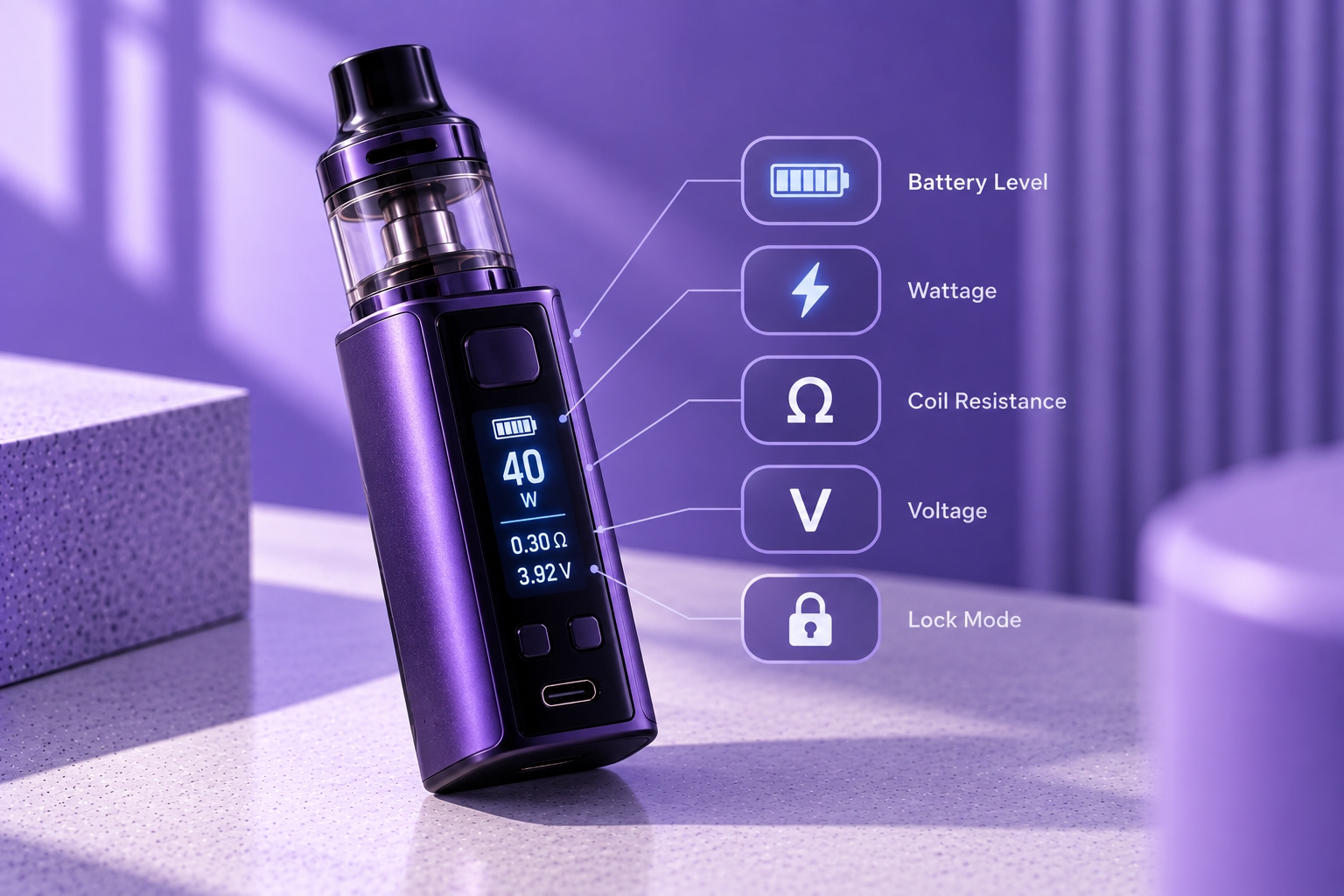
Vape screen symbols, abbreviations, warning messages, and menu layouts vary by manufacturer, chipset, and model. Use this guide as a general reference and confirm the exact meaning in your device manual before changing settings or responding to a protection warning.
Modern vape screens can display much more than battery level. Depending on the device, the display may show wattage, coil resistance, puff information, operating mode, lock status, temperature settings, charging information, or protection messages.
The important thing to remember is that there is no single universal screen layout. Two devices can communicate similar information using different icons, abbreviations, wording, or menu systems.
This guide explains the most common types of information you may encounter on a vape display and what they generally represent without treating model-specific symbols as universal.
Why Vape Screen Symbols Vary Between Devices
A vape screen is part of the device's user interface. What appears on it depends on the chipset, available features, coil system, controls, and software chosen by the manufacturer.
For example, one device may display a written warning such as CHECK ATOMIZER, while another may communicate an atomizer problem by flashing a resistance value or using different wording. Operating modes can also have manufacturer-specific names and abbreviations.
Because of these differences, the exact device manual should take priority whenever a symbol or message is unclear.
Battery Level Indicator
A battery icon or battery-level graphic generally indicates the remaining charge available to the device. Some screens use bars, while others may show a percentage or another graphical representation.
The displayed battery level should be treated as a device status indicator rather than a precise measurement of remaining vaping time. Actual runtime depends on factors such as battery capacity, output level, coil requirements, device efficiency, and usage.
Wattage or Power Display
On adjustable devices, a number followed by W normally represents the selected wattage or power setting.
Wattage controls how much electrical power the regulated device is set to deliver under the applicable operating conditions. The appropriate setting depends on the installed coil and the manufacturer's specifications rather than on one universal wattage value.
When adjusting an unfamiliar device, the coil's stated operating range and the manufacturer's instructions should take priority. The relationship between the setting and actual vape performance is covered more specifically in Puffin's vape wattage guide.
Ω or Resistance Reading
The omega symbol (Ω) represents electrical resistance measured in ohms. Many regulated devices display the detected resistance of the installed coil or atomizer.
The reading helps the device identify the connected load and operate within its supported specifications. Different coils are designed with different resistance values, so the number should be compared with the coil and device specifications rather than interpreted on its own.
A resistance reading that is unexpectedly absent, highly unstable, or substantially different from the expected coil value can indicate that something needs to be checked. This article does not diagnose those conditions because connection and atomizer errors have their own troubleshooting intent.
Voltage Display
Some screens display voltage using the letter V. What that number represents depends on the device and operating mode.
On certain regulated devices, the screen may display output voltage alongside wattage and resistance. Other devices or modes may present voltage differently. Check the manual before assuming that every voltage value on a vape screen represents the same measurement.
Puff Counter
A puff counter records activations according to the logic built into the device. It may appear as a number, a PUFF label, or within a separate statistics or settings menu.
A puff counter should not automatically be interpreted as an exact measurement of e-liquid consumption, nicotine intake, or remaining device lifespan. Draw duration, output, coil design, and device behavior can differ from one activation to another.
Puff Duration or Timer
Some screens display how long the most recent activation lasted, often in seconds. This is different from the total puff counter.
A puff-duration display is primarily informational. It should also not be confused with a device's firing-duration protection, which may stop output after a manufacturer-defined period.
Lock or Unlock Symbol
A padlock icon or a message such as LOCKED generally indicates that certain controls have been locked to prevent accidental changes or activation.
Exactly what becomes locked varies by device. Some models lock adjustment buttons while leaving other functions available, whereas others use different lock behaviors.
Do not assume that a familiar button combination applies to every device. Use the model's manual for the correct lock and unlock procedure.
Operating Mode Indicators
More advanced devices may display an abbreviation or label indicating the currently selected operating mode.
Examples found on different devices can include variable wattage, variable voltage, temperature-control, bypass, smart, eco, pulse, or manufacturer-specific modes. The same abbreviation should not automatically be assumed to behave identically across different chipsets.
If you do not recognize the selected mode, check the device manual before changing its settings.
Temperature and TC Indicators
Devices that support temperature-control functions may display a temperature setting, compatible coil-material mode, or related TC information.
Temperature-control implementation varies by chipset and compatible coil material. A displayed temperature should therefore be interpreted according to the manufacturer's description of that specific mode rather than as a universal measurement method across all devices.
Charging Indicator
When a rechargeable device is connected to power, its screen may show a battery animation, percentage, charging symbol, or other charging interface.
The exact display behavior varies. Some devices change the screen when charging is complete, while others stop charging automatically and display a full-battery state.
A charging symbol only indicates what the device interface is reporting. If a device fails to charge normally, that becomes a separate charging problem rather than a screen-symbol question.
New Coil or New Atomizer Message
Some regulated devices ask the user to confirm whether a newly detected atomizer or coil has been installed. The wording and controls vary by model.
This prompt allows compatible devices to recognize or update information associated with the attached atomizer. Follow the exact on-screen instructions and manufacturer documentation rather than assuming that every device handles a new coil in the same way.
What Does “Check Atomizer” or “No Atomizer” Mean?
Messages such as CHECK ATOMIZER or NO ATOMIZER generally indicate that the device is not detecting the expected atomizer or load correctly. The exact wording and trigger vary by model.
This is a protection or troubleshooting message rather than a normal operating symbol. The causes and diagnostic process belong to the dedicated No Atomizer troubleshooting page.
What Does “Short” or “Atomizer Short” Mean?
A message such as SHORT, SHORT ATOMIZER, or ATOMIZER SHORT indicates that the device has detected an electrical condition it interprets as a short-circuit or related protection condition.
Do not repeatedly attempt to fire the device to bypass the warning. Because causes, thresholds, and wording vary by model, diagnosis belongs in the dedicated Atomizer Short troubleshooting article.
What Does “Low Battery” Mean?
A LOW BATTERY or similar message generally means the device has reached a battery condition at which its protection system limits or stops normal operation.
The threshold and behavior are device-specific. Follow the manufacturer's charging instructions rather than treating the message as evidence of a defective battery by itself.
What Does “Over Time” or a Timeout Message Mean?
Some devices display OVER TIME, TIME OUT, or similar wording when continuous firing reaches the duration allowed by the device's protection system.
The cutoff duration is not universal. A timeout message should also be distinguished from a vape unexpectedly powering off. The behavior and reasons for a normal firing cutoff are covered separately.
What Does an Overheat Warning Mean?
Some devices display OVER HEAT, TOO HOT, or another temperature-related warning when the device's protection system detects a condition outside its permitted operating behavior.
If the device displays a temperature warning or becomes unusually hot, stop using it and follow the manufacturer's instructions. The specific causes and corrective steps belong to overheating troubleshooting rather than to interpreting the screen itself.
Screen Symbols vs. LED Indicators
A screen indicator and an LED indicator are not necessarily the same thing.
Screen-equipped devices can communicate information through numbers, words, icons, and menus. Devices without full displays may rely more heavily on colored or blinking LEDs to communicate battery status, activation, charging, or protection conditions.
Because LED colors and blinking patterns are also model-specific, their meanings are covered separately in the LED indicators article.
Quick Reference: Common Vape Screen Information
| Display | General Meaning |
|---|---|
| Battery icon | Remaining battery status |
| W | Selected wattage/power information |
| Ω | Detected coil/atomizer resistance |
| V | Voltage information, depending on device/mode |
| PUFF | Puff/activation counter or related information |
| Lock icon | Some controls are locked |
| Mode abbreviation | Current operating mode; exact meaning is device-specific |
| Check/No Atomizer | Atomizer/load detection warning |
| Short | Short-circuit or related electrical protection warning |
| Low Battery | Battery-related protection/status message |
| Over Time | Continuous-firing duration protection |
| Over Heat | Temperature-related protection warning |
What Should You Do When You Do Not Recognize a Symbol?
Start with the manual for the exact device model. Manufacturer documentation is especially important for abbreviated modes, protection messages, button-lock behavior, and model-specific icons.
If the display shows a protection warning, avoid repeatedly firing the device simply to see whether the message disappears. Identify what the manufacturer says the message represents and use the appropriate troubleshooting procedure for that condition.
Final Thoughts
Vape screens can show battery status, wattage, resistance, puff information, operating modes, lock status, charging information, and protection messages. These indicators make it easier to understand what a regulated device is reporting, but their exact appearance and meaning are not standardized across every vape.
Use common symbols as a starting point, then rely on the exact device manual when interpreting manufacturer-specific modes or warnings. If the screen reports a specific fault such as No Atomizer, Atomizer Short, or a firing cutoff, treat that message as a route to the appropriate diagnostic process rather than trying to solve every error from the display alone.
Sources & Further Reading
- Vaporesso — GEN 200 / GEN 80 S User Manual
- Vaporesso — XROS 4 Nano User Manual
- Vaporesso — XIRON User Manual
- Vaporesso — Device FAQ & Troubleshooting
Screen layouts and warning terminology vary by manufacturer and model. If a device displays an unfamiliar protection message, becomes unusually hot, reports unstable resistance, or behaves abnormally, stop using it until the message and cause have been identified using the manufacturer's instructions.